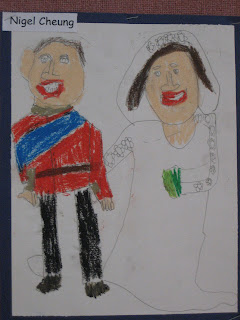
This is another post about some art I wanted to share with you, this time drawings by Hong Kong kindergarten students of the royal wedding. Aren't they gorgeous? My favourite one is of the Queen in her yellow hat.
Mandy is a wonderful Grade 12 student at ICS who has helped in my classroom this year. During our last week of school she presented me with this portrait she painted of the Bridges staff and students on Book Character Day (minus the green face paint, I'm thankful to say!) I am so thrilled and tickled by the painting, and am happy to have this tangible memory of Mandy when she leaves for college in the States. Amanda, if you want to see more of Mandy's fantastic art work you can read about her on my colleague's blog.
Last night I went out with some friends to see a musical comedy called “The Expat Wife”. One review described it as “a hysterical romp through the maze of social and cultural adjustments needed to survive the expatriate world”. The main character in the play, Felicity Edwards-Scott, has abandoned her career in England to dutifully follow her husband to Hong Kong. Together with their son, they must adapt to their new life as expatriates. This includes signing a work contract, finding an apartment, hiring a domestic helper, dealing with suddenly frizzy hair, and making new friends. Regarding the latter, Felicity meets a group of well-meaning international women who are Japanese, British (think Catherine Tate), American and Swiss-German, and they take her under their collective wing. She gets caught up in the whirlwind pace of an expatriate’s life and drifts further away from her husband and son. While I cannot say I entirely related to Felicity’s expatriate world of tennis matches, beauty salons, shopping sprees, and gin and tonic luncheons, I certainly identified with her difficulties with the language when trying to give a taxi driver directions, for example. My favourite character in the play was easily the Japanese expat wife, who delivered some hilarious lines (I think I may have actually snorted out loud when she called Felicity “Facility”) and perfected every flick of her wrist and tilt of her head. The singing Filipino maid had me in stitches too. There was a lot of dialogue, and the costumes were excellent. Another aspect of the play that impressed me was how it was fairly “clean”, and all the stereotyped characterizations were comically funny without being nasty. Perhaps the only downside to the play was that it was obviously written for an audience in Singapore, and some of the references to places and stores were irrelevant.
This was the group of ladies I went to the play with. They are mostly friends from ICS and playgroup. We are posing with Audrey Currie, fourth from the right, who wrote "The Expat Wife" and starred as the lead character, Felicity. I learned that she is Australian and was a member of the mother's group last year before she moved to Singapore with her family. I was thrilled to meet Audrey and congratulate her on a fantastic performance. She is just a mum like us, really down-to-earth, living in another country, and finding humour in her experiences as a stranger in a strange land.
“The Expat Wife” is playing all this week at the Shouson Theatre, Hong Kong Arts Centre.
Today was a public holiday in Hong Kong known as the Dragon Boat Festival. While we had every intention of watching one of the boat races, instead we ended up at Stanley for some shopping at the market. It was a particularly hot afternoon, and the children begged to go wading in the water. We had no swimsuits or towels with us, but the children did not complain. They made their own fun with the rubbish treasures they found on the beach, making sandcastles and splashing in the water.
I had a great time at Worship Central over the weekend. Martin Smith (front man of Delirious?) led the team on Friday night and was one of the speakers on Saturday. (I did feel old when he shared Cutting Edge came out 16-17 years ago!) One of the new things they tried this year to bring closer together our mutli-lingual Christian community was singing half the chorus/bridge in English and the other half in Chinese on a number of songs. Very cool! I think we'll see more of that in the future...and that's a good thing. Martin Smith thinks the worship leaders/teams of Asia's Christian churches have a critical role to play in the future outreach of Asia. It made me think about the future of Christian schooling in HK and Asia, and what schools can do differently to have a larger and broader impact on seeing God's Kingdom grow. What can Christian education groups like ours do differently to have a broader impact in not just HK but across Asia in the generations to come? More to come later on that thought...
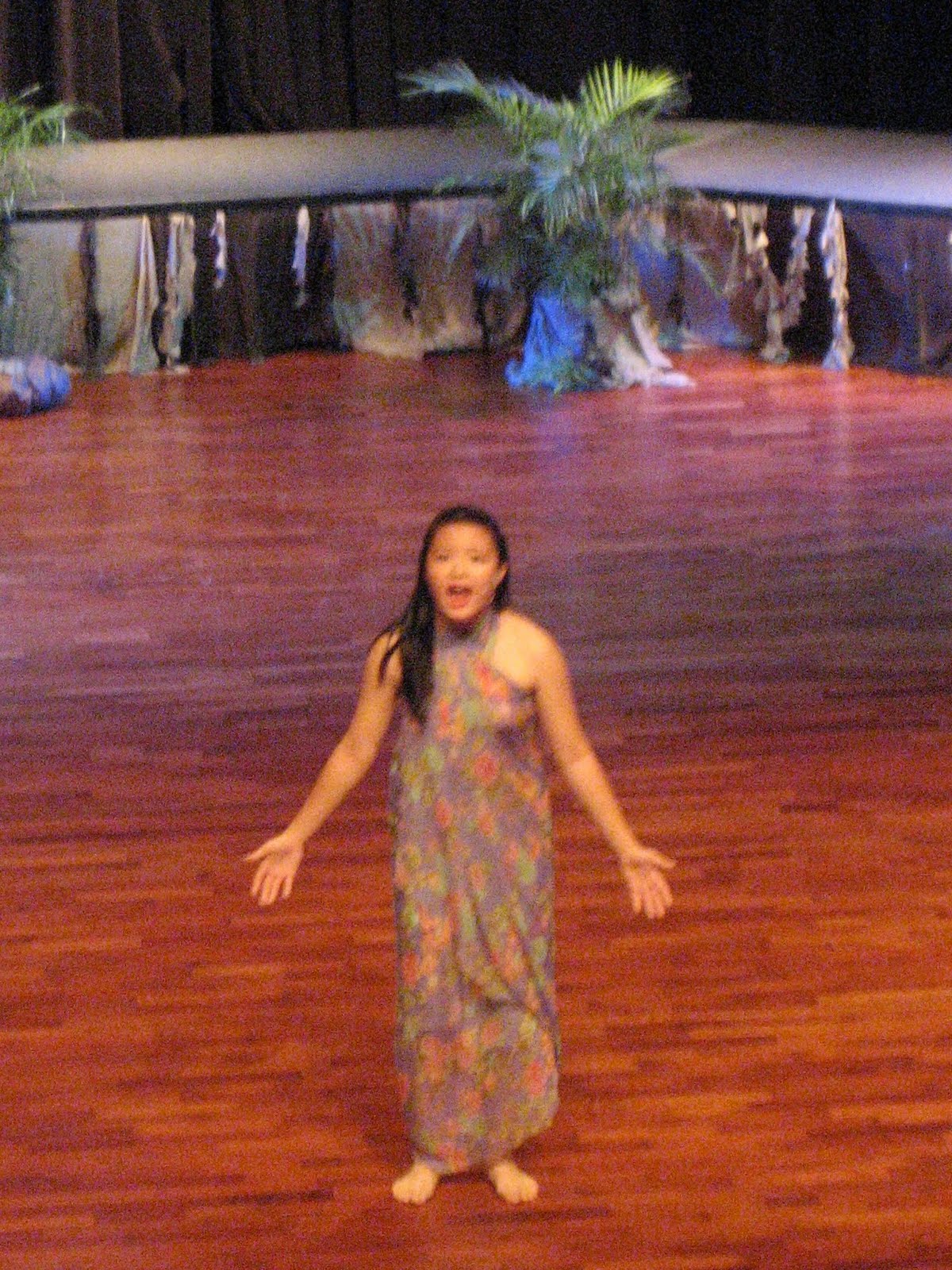
Tonight Jemilla and I attended a musical called "Once On This Island" performed by the ICS middle school drama team. Originally inspired by Hans Christian Anderson's "The Little Mermaid", it takes place on a Caribbean island.
Like "The Little Mermaid" or "Romeo and Juliet", it tells the story of forbidden love between people from two different worlds, in this case a peasant girl and a wealthy grand homme. The show focuses on the effects social class divisions have on love.
One day a terrible storm is unleashed upon the island. Little orphan Ti Moune is saved by seeking refuge in a tree above the flood's waters. She is found and subsequently adopted by peasants Mama and Tonton.
Years later, Ti Moune prays to God to reveal her purpose in life.
Shortly after, a wealthy young man named Daniel crashes his car during a storm.
Ti Moune meets Daniel and restores him to health and they fall in love. When "Death" comes calling to take Daniel's life, Ti Moune offers her life in exchange for Daniel's.
Daniel is reconciled with his wealthy family on the other side of the island, and Ti Moune goes to find him to supposedly marry him. During her travels, she is told that the earth will give her everything she needs on her journey to Daniel.
Ti Moune's parents reluctantly let her go.
At a ball, Ti Moune sees Daniel and Andrea, a daughter of family friends.
She learns that Daniel is engaged to be married to Andrea. Ti Moune is very hurt.
The Grim Reaper returns and and reminds Ti Moune of her promise to exchange her life for Daniel's. He encourages her to kill Daniel, just as Daniel had killed their love.
Ti Moune approaches Daniel but decides not to kill him. She proves that love is stronger than death but eventually dies herself.
And then Ti Moune is changed into a tree.
Her legacy survives and brings together another peasant girl and a young grande homme.
The people of the island are all united in song about the young peasant girl who showed the strength of love.
Jemilla and I enjoyed our night out together. The students did a great job on the costumes and dancing. However, I left the musical in a general state of confusion about the plot. I also felt "Once on this Island" was a odd choice for a Christian school as it was an obviously pagan story someone had tried to adapt to remove references to multiple gods and reincarnation. And after seeing the musical poster, Jemilla expressed disappointed that there were no mermaids involved.
It's true! This was our waitress at our restaurant tonight. Her name really is Monkey.
Many Chinese parents in Hong Kong give their children Western names at birth, but it is also common for young people here to choose their own English name to add to their Chinese names. It's kind of a rite of passage, and I've been told it makes them feel "more Westernized." At school there are students named Flame, Rainbow, and Purple. And our friend Paul once blogged about meeting a Rain,Windy, and Yummy at the same dinner. It is not entirely unlikely then to meet a sophisticated Chinese professional with a name like Sherlock, Tuscany, Psyche, Creamy, Cinderella, or Scholastica.
This post is a review of the book Gods of Noonday: A White Girl's African Life. Elaine Neil Orr was born in Nigeria in 1954, the daughter of medical missionaries. Her childhood coincided with coups and civil wars leading to independence from Great Britain. Intertwining the flourishing mission compound with Nigerian culture, furloughs in America with boarding school in Nigeria, and eventually Elaine’s crisis of kidney failure, the candid and powerful narrative builds in intensity as she recognises that only through recovering her homeland and her true identity can she find the strength to survive.
A kind friend, knowing that I had spent several years at a boarding school in Nigeria, recently sent me Gods of Noonday. She thought I might enjoy it, and I did, but it was gruelling to read. The author's rich and precise descriptions of Africa sent pangs to my heart. I could honestly only absorb a page or so at a time. My emotional response to the book surprised me. It must be a mark of a great author to make the reader feel like she is actually reliving the experiences on the pages and could have written parts of the story herself. As Elaine lived several decades before me in the south of Nigeria, there were only a few references to my region of Jos Plateau or the Hausa and Fulani people whom I knew. However, her various descriptions of "the beat of life in Nigeria" awoke many of my sleeping memories of Africa.
Here are just a few morsels from the book to try to help you understand my affinity with the author's accounts.
at the market twenty women selling the exact same things: "red peppers in mounds laid out in front...on a blue tarp, a small mountain of cassava in the background"
Nigerian way of speaking: using the phrase, "small, small" and accent "Ah-free-ka" (Africa), singing "Joy to de weld"
change in family dynamics when a sister left: "My sister had fallen off the edge of our secure domain and landed in boarding school far away"
watching a boy run alongside their car while rolling a metal wheel, keeping the momentum going with a stick
her family listening to the news on the BBC
a woman wearing one print wrap over a different print dress, an enormous blue and orange headdress, with her feet spilling over the back of her sandals
lizards inside the house and church
her mother pinning dress fabric to sewing patterns
Bata shoes
art work and paintings hung high on the wall
African coins with a hole in the middle
boarding school where after a while you adjust to a world "where relationships are distorted and you can't judge distance"
the smell of petrol fumes, goats, chickens, dried fish, smoking meat, urine, and dust
taking weekly allotment of bitter malaria medicine: "a good enough reason to abandon tropical Africa"
the missionaries playing singles and doubles tennis
so many items were recycled (newspaper, tin cans, car parts, glass jars, etc) "seeming to echo a hundred former lives"
sewing name tags on clothes for boarding school
living in a compound
chewing sticks to clean teeth
the metal drums used by missionaries for transporting their loads
an African man wearing a loose tunic in rich fabric reaching to his knees with ballooning sleeves that fold back over the shoulders, embroidery around the neck, flowing trousers, backless slippers, and sometimes a walking stick, patterns of scars on his cheeks
difficulty adjusting to boarding school and America which were both "artificial, easier to adjust to than you would guess, but resulting in a kind of basic separation from what should be closest to you: your country and your mother"
African children, their big bellies protruding, only wearing a string of beads around their hips
the flamboyant tree "that looks as though God painted it green and then tipped over a can of orange paint on top", playing with its long pods
plantains, palm nuts, ground nuts, roasted ears of corn with their hard and blackened kernels and enticing smells
gabon vipers and mambas
spotted enamel bowls
sign on a bar "Guiness is good for you; hot or cold"
African choir in church dancing and clapping their hands "but not like Americans, who hold their hands in front and gently bounce one off the other; instead they moved their whole arms"
beggars in Lagos whose knees bent backwards and walked along the street on their hands
being confronted by popular culture on furloughs where "everybody was so white my eyes hurt", trying desperately to fit in, where everything was new and fresh and clean and shiny, "the land of the better haircut and the home of the interstate", malls, trimmed lawns, TV, and supposed progress
feelings towards Nigeria: "I lean towards Nigeria like a plant toward a window...Nigeria is the place of my hidden self that is truer than my public self. It is the country of my heart."
An issue that especially rang true for me was the author's description of how her MK friends often disappeared on furloughs or at the end of school years with few explanations. "It was not until I came to live in the US many years later," Elaine writes, "that I realised it isn't necessarily normal to lose people as easily as the pebbles one puts in one's pocket and forgets to retrieve before the wash". She explains that occasionally her friends reappeared at boarding school "like the prodigal son" but the relationships had sadly altered and could not be repaired. In the book Elaine mourns these broken friendships and her failing health with this revealing statement: "If I were a calabash, I would not hold water."
Gods of Noonday is a heartfelt and melancholy memoir of a white American girl growing up in Nigeria, West Africa. In writing the book, Elaine verbalises the double-rootedness typically faced by many Third Culture Kids who share elements of their parents' culture and that of the other country in which they spend a significant part of their developmental years. She explains, "One needs a country as one needs a lover, as one needs a child, as one needs milk, as one needs a mother, as one needs a father, as one needs a god." I highly recommended the book to adult TCKs and parents of TCKs. There were so many truths in the book about the nature of the TCK experience and its effect on maturing, developing a sense of identity, and readjusting to one's passport country. As Elaine writes, "Anyone who thinks MK life is about the trauma of landing in Africa without prior knowledge of culture and country doesn't know anything about MK life. West Africa will take you in. The trauma is coming to America, which will not." She goes on to share how she felt (as I did) like a foreigner in America (Australia) but no one recognised her (me) as such, feeling "almost at home but never really home." Gods of Noonday beautifully reflected many of my personal challenges, feelings of rootlessness, unresolved grief, and struggles with identity due to my background. It held a mirror to my face and forced me to gaze at my reflection.
Thanks, Ellen, for sending me more than a book.
Renée Harvey (née Bissett), age 8, doing work duty in front of the dining hall at Kent Academy, Nigeria.
My second grade class at Kent Academy. I am on the far left.
I'm hoping one of my readers can help me out with a favour...
Does your child have a favourite teddy bear or comfort toy? This is Tirzah's special doll Alinta whom she has had since birth.
We brought a spare Alinta to Hong Kong and unfortunately she was left on the MTR one day and hasn't been seen since. So now we have one doll who is still carried just about everywhere. I would like to find another Alinta to have as a spare in case an accident should occur and during Alinta's baths in the washing machine.
Please could you look out for an identical doll in the shops near you?
Originally she was bought in a card and stationery shop like Kenny's Cardiology in Australia. She is a soft velour doll made by Russ Berrie and the name on her tag is "Melanie". If you see one, please let me know so I can purchase it and have some peace of mind. Thank you!
I am so excited to think that school will be over in just three weeks! It has been a hard year for me with the return to full-time teaching in a new special education class which necessitated the hiring of a domestic helper. With regards to the former, I am pleased with how my cohort of students with special needs is integrating into ICS. Regarding our helper Celene, I have learned some hard truths about myself and my controlling tendencies and my need to have some privacy in the home. I won't bore you with my struggles, but I will say that I am much happier now with our routines, and I am content with the amount of quality family time we are finding in our weeks.
We are thrilled to be coming to Perth for a long holiday from June 24 to July 27. The children have been preparing their lists of Important Things To Do In Australia. Just yesterday I received the wonderful news that my best friend Amanda will be able to fly over from New South Wales to spend time with me during our break. (Yay!) And some other friends have organised a house swap with us which is such an amazing blessing and so convenient. They will be holidaying in hot Hong Kong while we shiver away in Perth.
I am told by certain readers that I rarely post photos of myself on this blog, so here is a selection of four recent pictures to keep you-know-who-you-are happy.
This is the Student Services team at ICS with whom I work. Our group includes counsellours, nurses, admissions staff, and teachers. We attended a retreat together recently to plan for the coming year.
Here I am at a Survivor finale party cheering for Boston Rob to win.
These Hong Kong mums are all connected to the playgroup that Tirzah attends on Wednesdays. I take advantage of our social nights to get to know these women a bit better because I am working full-time and sadly unable to take Tirzah to her weekly playgroup myself.
Every day is a hard day working with students with special needs, but these two women make my job that much easier. Becky and Amy are my assistants with the Bridges class at ICS. They have a wealth of patience, common sense, compassion, and the ability to look for the ridiculous in everything. We were fooling around the day this photo was taken as it was a free-dress day and we chose to wear school uniforms. I love these ladies!